
Introduction: The Invisible Data Economy We’re All Part Of
You wake up, check your phone, and your AI-powered assistant already knows your schedule. As you scroll through social media, algorithms curate content specifically designed to capture your attention. At work, AI tools help analyze data and streamline processes. By bedtime, you’ve interacted with dozens of AI systems—but have you ever stopped to consider what these systems know about you?
In today’s digital landscape, artificial intelligence has woven itself into the fabric of daily American life, yet most users remain unaware of the extensive data collection practices happening behind the scenes. A recent iapp.org study reveals that 68% of consumers globally are either somewhat or very concerned about their privacy online, with 57% specifically identifying AI as a significant privacy threat. The startling reality is that while Americans increasingly enjoy AI’s conveniences, they’re simultaneously surrendering unprecedented amounts of personal information—often without meaningful consent or awareness of how it will be used.
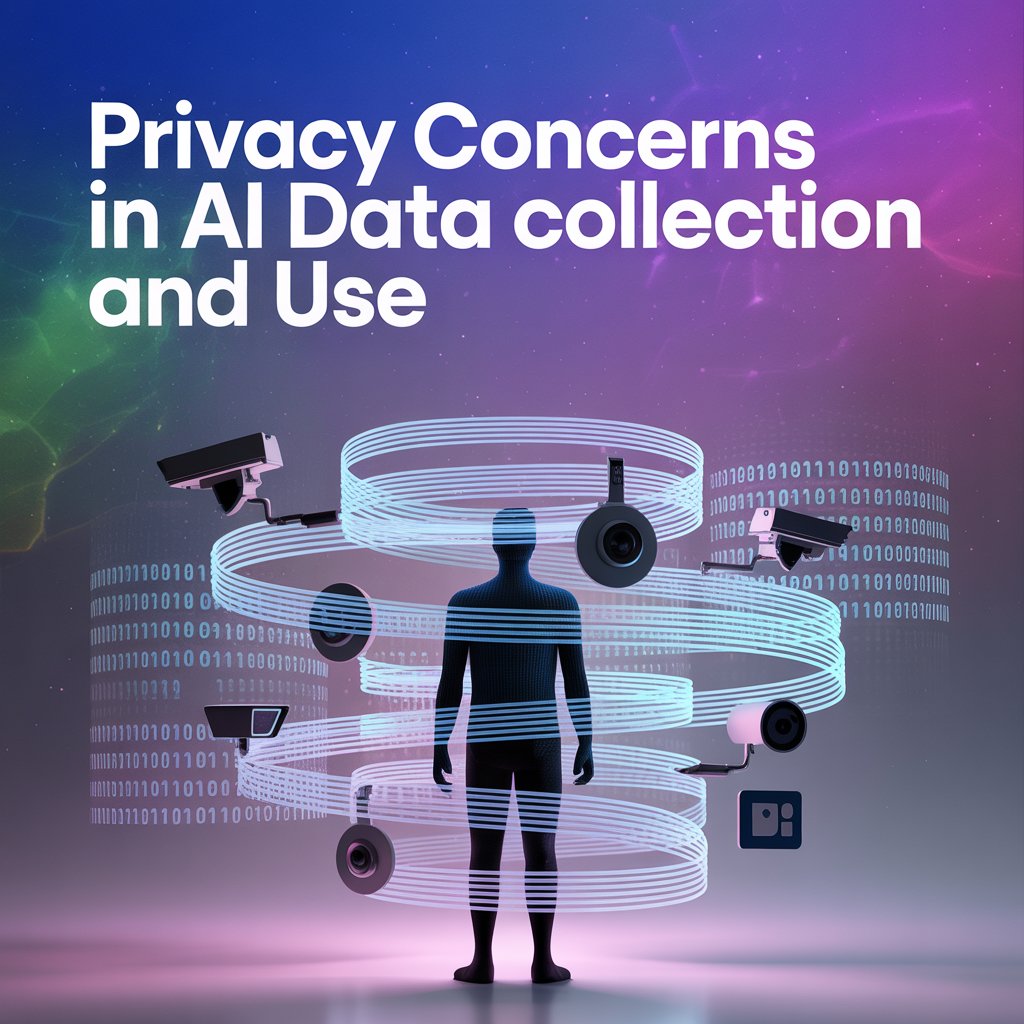
Consider this: AI systems don’t just collect what you explicitly share; they infer sensitive details from seemingly innocuous data points. Your shopping habits might reveal health conditions, your typing patterns could indicate emotional states, and your location data paints a precise picture of your personal life. This isn’t science fiction—it’s the current reality of AI-powered data collection in 2024. As Kashmir Hill reported in The New York Times, companies like Clearview AI have demonstrated how facial recognition technology trained on scraped public images can identify individuals with alarming accuracy—even protestors exercising their constitutional rights.
Understanding AI Data Collection: How It Really Works
AI systems require massive datasets to function effectively, creating what experts call the “data hunger” phenomenon. Unlike traditional software that follows predefined rules, AI—particularly machine learning models—learns patterns from data. This means the quality and quantity of data directly impact AI performance, creating powerful incentives for companies to collect as much information as possible. The unsettling truth is that most AI training happens without explicit individual consent, often using publicly available information scraped from websites, social media, and other digital footprints.
graph LR
A[Raw User Data] --> B(Data Aggregation)
B --> C(Model Training)
C --> D[AI System]
D --> E[Personalized Output]
E --> F[Further Data Collection]
F --> C
Consider chatbots like ChatGPT—you might think your conversations are private, but many platforms collect and store these interactions to improve their models. According to mdpi.com, “Privacy Concerns in ChatGPT Data Collection and Its Impact on Individuals” reveals how user inputs can inadvertently expose sensitive personal information that becomes part of ongoing training processes. When you share details about your health, finances, or personal relationships with an AI assistant, that information contributes to models that may eventually serve millions of other users—creating potential privacy leakage points you never consented to.
“The more an artificial intelligence system learns, the more comprehensive its knowledge becomes, making it possible for AI to predict future actions with unsettling precision.” — americanbar.org
This data collection ecosystem operates largely invisibly to consumers. Your smartphone listens for wake words, your smart TV tracks viewing habits, and even “dumb” devices like refrigerators collect usage patterns—all feeding the AI data pipeline. The scary part? These systems create detailed psychological profiles that can predict behavior more accurately than most friends or family members. Research published in ScienceDirect explains how AI creates “sophisticated inferences and predictions” from seemingly unrelated data points, building comprehensive pictures of individuals without their explicit understanding or consent.
The Four Major Privacy Threats AI Creates
Identity Inference and Profiling
AI doesn’t just collect what you explicitly share—it infers sensitive information you never intended to disclose. Machine learning algorithms can determine your political views from shopping habits, identify health conditions from typing patterns, and even predict criminal behavior from seemingly benign activities. A striking example emerged when a California artist discovered her private medical photos—thought to be securely stored—had been scraped into the LAION dataset used to train major AI models like Stable Diffusion. As noted in cacm.acm.org, this incident highlights how “photos she thought to be in her private medical record were included, without her knowledge or consent, in the LAION training dataset.”
Deepfakes and Synthetic Media
The rise of generative AI has created unprecedented risks for personal reputation and safety. In January 2023, Twitch streamer QTCinderella pleaded with followers to stop spreading AI-generated “deep fake” pornography of her and other women influencers, stating: “Being seen ‘naked’ against your will should not be part of this job.” These technologies enable malicious actors to create convincing fake content that can damage reputations, extort victims, or spread disinformation—all while using minimal original material. Unlike traditional photo manipulation, modern AI requires only a few images to generate highly realistic fake content that’s increasingly difficult to distinguish from reality.
Mission Creep in Data Usage
One of AI’s most insidious privacy threats is “mission creep”—where data collected for one purpose gets repurposed in unexpected, often harmful ways. As revealed by iapp.org, 81% of consumers think the information collected by AI companies will be used in ways people are uncomfortable with, including purposes never originally disclosed. Law enforcement’s use of Clearview AI to identify Black Lives Matter protestors exemplifies this problem—technology marketed for finding missing persons became a surveillance tool against peaceful demonstrators. Your fitness tracker data might help insurance companies deny coverage, while your social media activity could influence loan approvals through invisible scoring systems you never agreed to.
Algorithmic Surveillance and Social Control
Perhaps the most profound privacy concern is AI’s role in enabling mass surveillance infrastructure. Facial recognition systems deployed by police departments, workplace monitoring software, and predictive policing algorithms create ecosystems of constant observation. Unlike traditional surveillance that targets specific individuals, AI-powered systems monitor entire populations, analyzing behavior patterns to identify “suspicious” activity based on opaque criteria. A Pew Research Center survey found consumers worry these systems will “make it harder for people to keep their personal information private,” creating chilling effects on free expression and assembly as people modify behavior to avoid algorithmic scrutiny.
Real-World Consequences of AI Privacy Failures
| Incident | Company/Technology | Privacy Impact | Consumer Response |
|---|---|---|---|
| Clearview AI | Facial recognition | Scraped 3B+ images without consent | Multiple lawsuits, banned by Google/Facebook |
| ChatGPT Data Leak | OpenAI | Accidental exposure of payment info, conversation titles | Temporary suspension in Italy, EU scrutiny |
| LAION Dataset | AI training data | Included private medical images without consent | Artist advocacy, renewed focus on data provenance |
| Deepfake Pornography | Generative AI | Non-consensual intimate imagery of celebrities/influencers | Congressional hearings, state legislation proposals |
The consequences of AI privacy breaches extend far beyond data exposure—they can destroy reputations, damage careers, and even endanger physical safety. When facial recognition incorrectly identifies someone as a suspect (which happens more frequently to women and people of color), innocent people face police interrogation or arrest. When health conditions are inferred from shopping data, individuals may face insurance discrimination or social stigma. When algorithms determine creditworthiness based on non-financial behaviors, people can be unfairly denied economic opportunities.
Consider this chilling scenario: You search online for mental health resources after a difficult week. An AI system notes your search history, correlates it with your reduced social media activity, and flags you as “high risk.” This profile gets shared with potential employers through background screening services, costing you a job opportunity—all based on data you never intended to share publicly and assumptions made by algorithms you’ve never seen. While this exact scenario might not have happened yet, the technological components exist today and operate largely without oversight.
Navigating the Regulatory Landscape
Current US Approach: Fragmented and Reactive
Unlike the comprehensive EU AI Act that classifies AI systems by risk level and imposes strict requirements for high-risk applications, the US approach remains patchwork and industry-specific. Currently, no federal law specifically governs AI data practices, though several existing frameworks apply partially:
- Sectoral Regulations: HIPAA for health data, GLBA for financial information, and FERPA for educational records provide limited protections in specific domains
- State Laws: California’s CCPA/CPRA, Virginia’s CDPA, and other state privacy laws create varying standards across the country
- Sector-Specific Guidance: FTC warnings about algorithmic bias and enforcement actions against deceptive AI practices
graph LR
US[US Approach] --> Fragmented[Fragmented Regulation]
US --> SelfReg[Industry Self-Regulation]
EU[EU Approach] --> Comprehensive[Comprehensive AI Act]
EU --> RiskBased[Risk-Based Classification]
The americanbar.org analysis notes that “both the EU and the United States have recently proposed comprehensive measures to govern AI,” but implementation differs significantly. While the EU AI Act establishes clear boundaries with prohibitions on certain applications (like social scoring), US proposals focus more on voluntary frameworks and sector-specific rules that lack enforcement teeth.
“One of the public’s biggest concerns related to AI is that it will have a negative effect on individual privacy.” — Pew Research Center via iapp.org
This regulatory gap creates uncertainty for both businesses and consumers. Companies struggle to comply with inconsistent standards across states, while consumers lack clear avenues for recourse when AI systems misuse their data. The absence of federal AI legislation means that for now, the primary protection against AI privacy violations remains companies’ self-imposed ethics guidelines—rules that often bend when profits are at stake.
Practical Steps for Protecting Your Privacy
For Consumers: Taking Back Control
Click for Consumer Privacy Checklist
- Review privacy settings on all AI-powered applications monthly
- Opt out of data sharing/sharing whenever possible
- Use separate email addresses for different service categories
- Regularly delete conversation history with AI assistants
- Research companies’ data policies before using new tools
- Enable two-factor authentication everywhere possible
- Use privacy-focused alternatives when available (e.g., DuckDuckGo)
- Be mindful of what you share—even seemingly harmless details
- Check which apps have microphone/camera access regularly
- Use virtual credit cards for online transactions
- Read Privacy Policies (At Least the Summaries): While tedious, these documents reveal how companies use your data. Look for phrases like “we may share your information with third parties for AI training purposes.”
- Adjust Settings Aggressively: Most platforms hide privacy controls deep in settings. Disable voice recording storage, conversation history tracking, and personalized advertising where possible.
- Assume Everything Is Recorded: Treat AI interactions like public conversations—never share sensitive information you wouldn’t want permanently stored and potentially analyzed.
- Diversify Your Digital Footprint: Use different usernames or email aliases for different services to prevent companies from building comprehensive profiles across platforms.
As the ScienceDirect study explains, “different types of AI affect traditionally studied privacy decision-making frameworks including the privacy calculus, psychological ownership, and social influence in varied ways.” Understanding these dynamics helps consumers make more informed choices about what to share and with whom.
For Businesses: Ethical AI Development Practices
Companies developing or deploying AI must balance innovation with responsibility. Consider implementing these practices:
- Data Minimization: Collect only what’s absolutely necessary
- Purpose Limitation: Don’t repurpose data beyond original consent
- Transparency: Clearly explain how AI uses personal information
- Human Oversight: Ensure meaningful human review of AI decisions
- Regular Audits: Test for bias and privacy vulnerabilities
Document your data flows with a simple table like this:
| Data Type | Collection Purpose | Storage Duration | Access Controls | Deletion Process |
|---|---|---|---|---|
| User Inputs | Improve model accuracy | 30 days (anonymized) | Restricted team access | Automatic after 30 days |
| Usage Patterns | Feature optimization | 6 months | Engineering team only | Manual review required |
| Demographic Data | Personalization | Until user deletes account | Product team access | User-initiated |
The Path Forward: Building Privacy by Design
The future of AI doesn’t have to be a privacy dystopia—if we act now. As AI capabilities grow exponentially, our privacy protections must evolve at matching pace. The good news is that privacy-preserving AI techniques like federated learning (training models on-device without centralizing data), differential privacy (adding statistical noise to protect individuals), and homomorphic encryption (processing encrypted data) show that innovation and privacy can coexist.
Congressional hearings on AI privacy are increasing, with bipartisan recognition that America needs stronger safeguards. Industry leaders are beginning to adopt voluntary frameworks like the AI Risk Management Framework from NIST, which provides concrete guidance on privacy considerations throughout the AI lifecycle. As these efforts mature, consumers will gain more control while businesses benefit from increased trust—a win-win scenario possible only through thoughtful regulation and ethical implementation.
The relationship between AI and privacy presents Americans with a critical choice: will we build systems that respect individual autonomy while delivering AI’s benefits, or will we trade privacy for convenience until there’s nothing left to protect? The technology itself isn’t inherently good or bad—it’s how we choose to develop and deploy it that determines whether AI becomes a tool for liberation or control. As we stand at this technological crossroads, one truth remains clear: in the age of artificial intelligence, privacy isn’t just about hiding information—it’s about preserving human dignity in a world increasingly shaped by algorithms.