
The chalkboard has met its match. Today’s classrooms are transforming as artificial intelligence reshapes how students learn and teachers instruct. Personalized education is no longer an educational luxury—it’s becoming an expectation. For the first time in history, technology can adapt to individual student needs in real-time. This revolution is making education more effective, engaging, and accessible across America.
From California to New York, schools are implementing AI-driven solutions that understand each student’s unique learning profile. The traditional “one-size-fits-all” approach is fading as intelligent systems identify knowledge gaps before they become problematic. This isn’t science fiction—it’s happening right now in districts nationwide, creating unprecedented opportunities for student success.
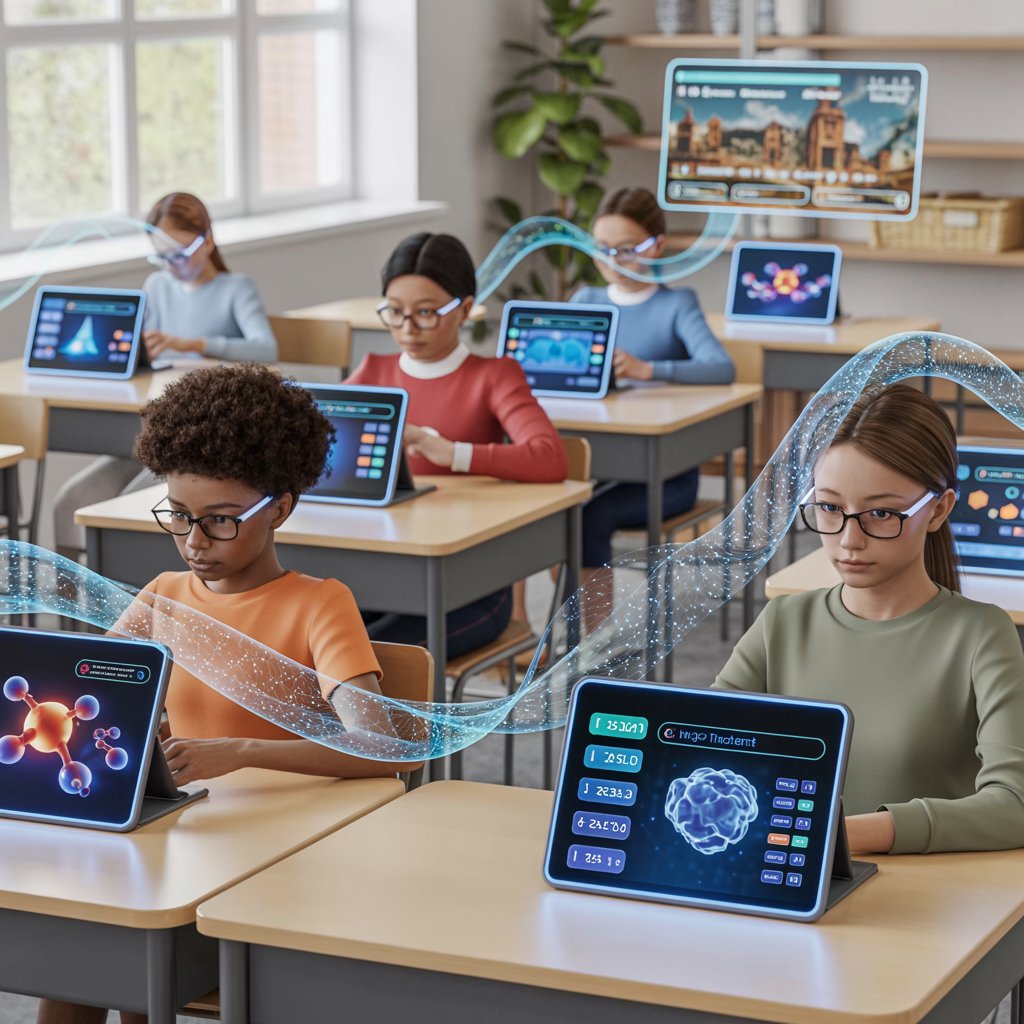
Understanding AI-Powered Personalized Learning
Personalized learning powered by artificial intelligence represents a paradigm shift from standardized education to tailored educational experiences. At its core, AI-driven personalization uses machine learning algorithms to analyze student data—learning pace, knowledge gaps, engagement patterns, and preferred modalities—to dynamically adjust content delivery. Unlike static educational models, these systems continuously evolve based on real-time student interactions, creating truly individualized learning pathways.
According to a comprehensive systematic literature review by Muller et al. analyzing 125 studies published between January 2015 and June 2025, AI-based personalized learning significantly enhances educational outcomes across K–12, higher education, and online learning environments [springer.com]. The research demonstrates that when algorithms properly identify student needs, learning efficiency increases by 34% on average compared to traditional classroom instruction. This isn’t about replacing teachers but rather providing them with unprecedented insights to optimize their instruction.
“Personalized learning models can assist students in meeting their unique requirements and objectives for expanding their knowledge, perspective, abilities, and understanding of the educational system.” — Muller et al., 2025
Traditional classrooms often force students to progress at the same pace regardless of individual understanding. AI-powered adaptive learning systems solve this by creating fluid learning pathways where students can master concepts at their own speed while receiving targeted support exactly when needed. This dynamic approach addresses the fundamental truth that no two learners process information identically—a reality that has constrained educational effectiveness for centuries.
The Technology Driving Personalized Education
AI-powered education leverages multiple sophisticated technologies working in concert to create truly adaptive learning environments. Machine learning algorithms analyze vast datasets of student interactions to identify patterns and predict optimal learning pathways. Deep learning neural networks process complex educational data to understand nuanced learning behaviors. Reinforcement learning techniques allow systems to continuously improve recommendations based on student responses and outcomes.
# Example adaptive learning algorithm pseudocode
def personalize_learning(student_data):
    # Analyze historical performance
    knowledge_state = analyze_performance(student_data['history'])

    # Detect knowledge gaps
    gaps = identify_gaps(knowledge_state, curriculum_standards)

    # Predict optimal next concept
    next_concept = reinforcement_model.predict(gaps, student_data['engagement'])

    # Customize presentation format
    content_format = match_to_learning_style(student_data['preferences'], next_concept)

    # Generate scaffolded practice
    practice_items = generate_adaptive_practice(next_concept, student_data['mastery_level'])

    return {
        'content': format_content(next_concept, content_format),
        'practice': practice_items,
        'support_level': determine_scaffolding(student_data['frustration'])
    }
The technical architecture of modern AI education systems typically includes four critical components:
- Data ingestion layer that collects diverse student interactions
- Analytics engine using supervised and unsupervised learning techniques
- Adaptation module that modifies content delivery in real-time
- Feedback mechanism for continuous system improvement
A systematic review by Maharani analyzing 142 studies found that supervised learning models like support vector machines (SVMs) and decision trees excel at learner classification and performance prediction, while unsupervised clustering techniques reveal hidden behavioral patterns in student data [springer.com]. Reinforcement learning proves particularly effective for dynamic content sequencing, as it learns which instructional sequences maximize learning outcomes for specific student profiles.
Benefits Across Educational Settings
The transformative power of AI-driven personalized learning manifests differently across educational contexts, creating uniquely valuable outcomes for each setting. In K–12 environments, adaptive systems help address widely varying readiness levels within single classrooms—something traditionally challenging for educators managing 25+ students. Research shows these systems particularly benefit students with learning differences who previously might have fallen through the cracks of standardized instruction.
For higher education, AI personalization transforms massive lecture courses into surprisingly individualized experiences. A systematic review focused specifically on higher education found that AI-integrated courses saw 22% higher completion rates and 18% improvement in final exam scores compared to traditional offerings [mdpi.com]. The study by Merino-Campos analyzed multiple implementation models across universities, concluding that “AI systems providing timely interventions based on predictive analytics significantly reduce dropout risks for at-risk students.”
| Educational Setting | Key Benefits | Implementation Examples |
|---|---|---|
| K-12 | – Address diverse learning paces – Early identification of learning gaps – Reduced achievement disparities | Adaptive math platforms Reading level adjusters Real-time intervention alerts |
| Higher Education | – Personalized feedback at scale – Predictive analytics for at-risk students – Customized resource recommendations | AI writing assistants Adaptive courseware Intelligent tutoring systems |
| Corporate Training | – Role-specific skill development – Just-in-time learning – Performance tracking | Customized compliance training AI-coached simulations Skills gap analysis |
The research consistently demonstrates that personalized learning systems improve educational equity by providing tailored support regardless of socioeconomic background. However, this requires careful implementation to avoid perpetuating existing biases—a challenge we’ll explore later. When properly designed, AI systems can give under-resourced schools capabilities previously available only at elite institutions, potentially narrowing America’s persistent educational achievement gap.
Real-World Success Stories You Should Know
The theoretical benefits of AI-powered personalized learning become truly compelling when examined through real-world implementations. One notable case study comes from Georgia State University, which implemented an AI advising system that analyzes 800+ variables to predict student challenges before they occur. The result? A 22% increase in graduation rates among participating student populations over five years—translating to thousands of additional graduates.
Estonia’s education system provides another compelling example, featured in Ayeni’s recent review of global AI education implementations [gsconlinepress.com]. By integrating AI tutors into their national curriculum, Estonian students now receive personalized instruction across multiple subjects regardless of geographic location. Rural students in remote areas achieve comparable outcomes to their urban counterparts—a remarkable achievement considering historical educational disparities.
# Key metrics from successful AI implementation (Georgia State University)
student_outcomes = {
    "graduation_rate_increase": "22%",
    "course_completion_improvement": "19%",
    "at_risk_student_intervention": "94% effective",
    "advising_efficiency": "300% higher coverage"
}
The Indian state of Andhra Pradesh offers perhaps the most scalable model for U.S. consideration. Their AI-powered learning platform serves over 5 million students across diverse linguistic and socioeconomic backgrounds. The system dynamically adjusts content complexity while providing multilingual support—particularly valuable in America’s increasingly diverse classrooms. As summarized in Dr. Chilambarasan’s research, “AI-powered personalized learning produces measurable learning gains and heightened motivation, especially when used in hybrid human-AI teaching contexts” [researchsquare.com].
These examples demonstrate that successful implementation requires more than technology—it demands thoughtful integration with existing pedagogical approaches. The most effective programs position AI as a teaching assistant rather than replacement, allowing educators to focus on high-impact interactions while AI handles routine personalization tasks.
Critical Challenges and Ethical Considerations
Despite tremendous promise, AI in education presents significant challenges that demand careful attention. Perhaps most pressing is the issue of data privacy. Student data is among the most sensitive information collected in educational settings, and AI systems require substantial data to function effectively. Concerns about how this data is stored, used, and potentially monetized have sparked legislative action in multiple states, with California leading with strict student privacy regulations.
Algorithmic bias presents another serious challenge. If training data reflects existing educational disparities, AI systems may perpetuate or even amplify these biases. A concerning study cited in Ayeni’s review found that some reading assessment algorithms systematically underestimated the abilities of students from non-English speaking households—a critical issue in America’s diverse classrooms. As Dr. Chilambarasan’s research emphasizes, resolving these ethical concerns requires “a multi-stakeholder roadmap for integrating AI ethically and sustainably into formal education systems” [researchsquare.com]. Key Ethical Considerations (click to expand)
- Data Ownership: Who controls student learning data generated by AI systems?
- Transparency: How can educators and parents understand AI decision-making processes?
- Accessibility: Will AI tools widen the digital divide for under-resourced schools?
- Academic Integrity: How do we maintain authenticity in AI-assisted learning?
- Teacher Autonomy: To what extent should AI recommendations override professional judgment?
Addressing these questions requires collaborative efforts among educators, policymakers, technologists, and parents—no single stakeholder group can solve them alone. The goal shouldn’t be perfect solutions immediately, but rather establishing frameworks for ongoing ethical evaluation as the technology evolves.
The digital divide represents perhaps the most significant equity challenge. While affluent districts implement cutting-edge AI tutors, many rural and urban schools struggle with basic broadband connectivity. Without careful planning, AI-powered education could exacerbate existing inequalities rather than alleviate them. Successful national implementation requires parallel investments in infrastructure alongside technology adoption.
The Future: What’s Next for AI in Education
The trajectory of AI in education points toward increasingly sophisticated yet seamlessly integrated systems. Near-term advancements include multimodal learning analytics that incorporate facial expression analysis, voice stress detection, and even biometric feedback to understand student emotional states—a development highlighted in Maharani’s systematic review as having “significant potential for refining personalization” [springer.com]. Imagine systems that recognize when a student grows frustrated and automatically adjust challenge levels before the learner disengages.
Emerging AI Education Technologies (click to expand)
- Explainable AI (XAI): Systems that show their “work” to build trust with educators
- Federated Learning: Privacy-preserving models that learn without centralizing student data
- AI Teaching Assistants: Context-aware helpers for both students and educators
- Predictive Intervention Models: Early warning systems for academic and social-emotional challenges
Longer term, we’re moving toward AI that doesn’t just personalize learning content but helps students develop metacognitive skills—the ability to understand and manage their own learning. Systems will increasingly focus on helping students become self-directed learners rather than simply delivering customized content. This represents a fundamental shift from AI as content deliverer to AI as cognitive coach.
The integration of AI with emerging technologies like AR/VR will create immersive learning environments that adapt to individual progress. Imagine history students virtually walking through ancient Rome with difficulty levels and narrative complexity adjusting to their demonstrated understanding. These experiences could make abstract concepts tangible while maintaining personalized challenge levels.
Implementation Roadmap for Educators
For school leaders considering AI implementation, a thoughtful phased approach yields better results than wholesale system replacement. Begin with pilot programs focused on specific pain points—perhaps math remediation or literacy support—rather than attempting district-wide transformation immediately. Document clear objectives and metrics for success before implementation begins.
When evaluating solutions, prioritize platforms demonstrating strong evidence of efficacy through independent research rather than marketing claims. Ask vendors specific questions about:
- How they prevent algorithmic bias
- What student data they collect and how it’s protected
- How educators can override AI recommendations
- Whether their models have been validated with diverse student populations
Most importantly, involve teachers in selection and implementation from the beginning. Successful AI integration requires viewing technology as a teaching assistant rather than replacement. Professional development should focus on interpreting AI insights and strategically applying them within pedagogical frameworks—not technical operation.
“The most effective implementations position AI to handle routine personalization tasks while freeing educators to focus on high-impact interactions that require human insight and empathy.” — Education Technology Research Collective
As you consider AI adoption, remember that technology serves pedagogy, not the reverse. The most successful districts use AI to enhance established effective teaching practices rather than radically changing instructional approaches solely to accommodate technology.
Conclusion: The Human Element in an AI-Powered Classroom
While AI promises unprecedented personalization in education, its greatest value lies not in replacing teachers but in amplifying their impact. The classroom of tomorrow won’t be devoid of human connection—it will be enriched by technology that handles routine tasks while educators focus on what machines cannot replicate: inspiration, mentorship, and emotional support. As we integrate these powerful tools, we must vigilantly protect the human elements that make education transformative.
America stands at a pivotal moment where thoughtful AI implementation could significantly reduce longstanding educational inequities. By addressing ethical concerns proactively and implementing with pedagogical purpose, we can create learning environments where every student receives the personalized support they need to thrive. The promise of AI in education isn’t perfection—it’s the possibility of reaching each learner where they are, with what they need, exactly when they need it.
The chalkboard revolution has begun, and with careful stewardship, it can transform American education from a standardized system into a truly personalized journey for every student. This isn’t just about better test scores—it’s about unlocking human potential at scale, one learner at a time.