
What if the next blockbuster you watched was partly written, cast, and scored by a machine? That’s no longer science fiction. The AI market in entertainment is projected to surpass $99 billion by 2030, and the transformation is already well underway — reshaping every layer of how stories are told, games are built, and content is delivered to billions of people worldwide.
Artificial intelligence in the entertainment industry isn’t a sudden disruption. It’s a slow-burning revolution that began with early neural networks optimizing game pathfinding in the 1990s and has escalated into generative AI tools capable of producing photorealistic faces, writing screenplay drafts, and composing full orchestral scores. Today, machine learning entertainment applications touch everything from the NPCs chasing you in a video game to the reason Netflix queues up exactly the right show at exactly the right moment.
This article takes a comprehensive look at how AI is transforming entertainment across three primary domains: gaming, film and visual storytelling, and streaming and broader ecosystems. We’ll also examine the ethical tensions this technology creates and offer a grounded look at where things are heading. Whether you’re a tech-savvy gamer, an indie filmmaker, or simply someone who streams three hours a night, AI is quietly rewriting the rules of your entertainment experience.
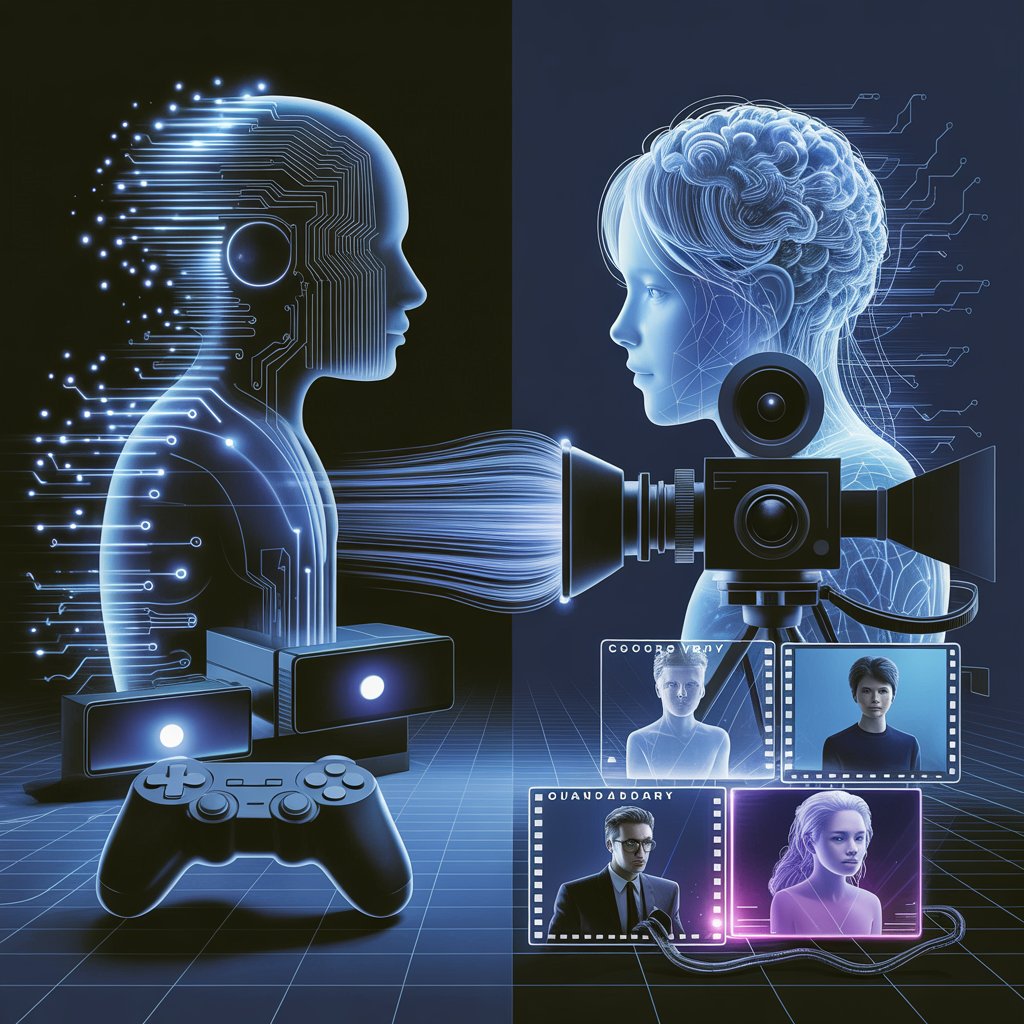
AI-Powered Gaming: Smarter NPCs and Procedural Worlds
For decades, game developers relied on hand-crafted rule sets — finite state machines, scripted events, and decision trees — to simulate intelligent behavior. It worked, but it had a ceiling. Characters behaved predictably, worlds felt hand-stamped, and difficulty scaling was crude. Machine learning in gaming has shattered that ceiling.
The most celebrated early example of procedural generation is No Man’s Sky, where Hello Games used algorithmic and AI-assisted techniques to generate over 18 quintillion unique planets. Every terrain, ecosystem, and creature is synthesized in real time — an approach that would be physically impossible with hand-built design. More recently, reinforcement learning games like DeepMind’s AlphaStar demonstrated that AI could master StarCraft II at a superhuman level, adapting strategies in real time against professional players. That same philosophy of adaptive, learning-based AI is now filtering into commercial titles.
In The Last of Us Part II, Naughty Dog’s engineers built NPC companions and enemies with dynamic behavior trees powered by neural networks — enemies call out to each other by name, flank intelligently, and react to the player’s specific actions. This produces encounters that feel genuinely alive rather than scripted. Meanwhile, studios like Ubisoft are deploying Ghostwriter, an in-house AI tool that generates first-draft barks and ambient dialogue for NPCs, freeing writers to focus on narrative depth.
Personalization and Immersive Experiences
AI personalization in gaming is extending the Netflix recommendation model into interactive worlds. Dynamic difficulty adjustment (DDA) systems — seen in games like Resident Evil 4 and Assassin’s Creed — quietly monitor player performance and tune enemy aggression, puzzle complexity, and resource availability in real time. The result is a smoother, more satisfying experience tailored to each individual player without them ever seeing a settings menu.
Platforms like Roblox are pushing this further. Their AI-powered tools allow creators — many of them teenagers — to generate game assets, terrain, and even basic scripts using natural language prompts. This democratizes game development in a way that mirrors how generative AI tools have democratized visual art. In the metaverse space, companies are using computer vision entertainment systems to map real-world environments into immersive virtual spaces and enable expressive avatar animations driven by facial tracking.
Top AI Gaming Innovations at a Glance:
- Procedural world generation (No Man’s Sky, Minecraft)
- Reinforcement learning opponents (AlphaStar, chess engines)
- AI-generated NPC dialogue (Ghostwriter, Inworld AI)
- Dynamic difficulty adjustment (Resident Evil, Assassin’s Creed)
- Natural language game creation tools (Roblox AI, Unity Muse)
- Real-time player behavior analytics for engagement optimization
Traditional vs. AI-Enhanced Game Development
| Feature | Traditional Method | AI Method | Examples |
|---|---|---|---|
| World Building | Hand-crafted maps and assets | Procedural generation via ML | No Man’s Sky, Dwarf Fortress |
| NPC Behavior | Scripted decision trees | Neural network behavior models | The Last of Us Part II, F.E.A.R. |
| Dialogue | Fully written by writers | AI-drafted, human-refined | Ghostwriter (Ubisoft), Inworld AI |
| Difficulty Scaling | Preset difficulty tiers | Real-time DDA via player data | Resident Evil 4, FIFA |
| QA Testing | Manual playtesting | AI bots simulating player runs | EA, Activision internal tools |
| Art Asset Creation | Artist-produced from scratch | AI-assisted generation + polish | Midjourney, DALL·E, Adobe Firefly |
Generative AI in Movies: From Scriptwriting to Deepfakes
Hollywood has always been an industry of illusion — but AI is changing not just the tricks, but who performs them and at what cost. Generative AI in movies now reaches into scriptwriting, casting analysis, storyboarding, deepfake production, and post-production VFX, compressing timelines and opening creative possibilities that were previously reserved for studios with nine-figure budgets.
On the scriptwriting side, tools like ScriptBook use deep learning to analyze screenplays and predict box office potential, genre fit, and audience sentiment before a single frame is shot. Major studios have quietly used similar predictive analytics entertainment tools to greenlight or pass on projects. While no AI is fully writing Hollywood blockbusters yet, tools like ChatGPT and Claude are being used by writers to develop outlines, punch up dialogue, and brainstorm plot alternatives — accelerating the development process significantly.
The most publicly visible (and controversial) application has been deepfakes in Hollywood. In Rogue One: A Star Wars Story (2016), Industrial Light & Magic used AI-assisted facial recreation to portray a young Princess Leia using Carrie Fisher’s likeness. James Dean was digitally resurrected for a 2020 film using archival footage and AI reconstruction. More recently, synthetic media film technology allowed filmmakers to de-age actors convincingly — Robert De Niro in The Irishman, Samuel L. Jackson in Captain Marvel — using machine learning models trained on thousands of reference frames.
Storyboarding and pre-visualization have also been disrupted. Directors and production designers now use tools like Midjourney, Adobe Firefly, and Stable Diffusion to rapidly generate concept art, lighting studies, and scene compositions in hours rather than weeks. This is a fundamental shift in the pre-production pipeline, particularly for independent filmmakers with limited budgets.
Virtual Production and VFX Overhaul
Perhaps nowhere is the AI revolution more visually stunning than in virtual production — and nowhere is the change more concrete than on the set of The Mandalorian. Lucasfilm’s Industrial Light & Magic developed StageCraft, a system using massive LED walls displaying photorealistic real-time environments powered by Unreal Engine and AI-driven rendering. Actors perform in front of these walls, eliminating location travel and dramatically reducing green-screen compositing work in post-production.
Neural networks for VFX have also matured into indispensable tools. NVIDIA’s AI upscaling (DLSS) and similar technologies are now used in film workflows to enhance resolution and reduce rendering costs. AI de-aging tools process facial geometry and skin texture frame by frame with a fidelity that would have required months of manual VFX work a decade ago.
The AI pipeline in a modern blockbuster might now include:
- Pre-production: AI script analysis, AI-generated concept art, casting analytics
- Production: Virtual production LED stages, real-time AI rendering, performance capture
- Post-production: AI de-aging/deepfake compositing, AI upscaling, automated rotoscoping
- Distribution: AI-powered color grading optimization for different display standards
Deep learning Hollywood production tools like Topaz Video AI and Runway ML can now handle tasks like background removal, object tracking, and even scene interpolation with minimal human supervision — jobs that once employed entire departments of VFX artists.
Personalization, Content Creation, and Beyond
The AI transformation in entertainment extends well beyond games and films into the vast ecosystem of streaming platforms, music, live events, and interactive media. Here, AI’s primary power is in understanding and predicting human behavior at scale.
AI Personalization in Streaming
Netflix’s recommendation engine is perhaps the most famous application of AI personalization in streaming. Using collaborative filtering, deep learning, and A/B testing at massive scale, Netflix estimates its recommendation system saves over $1 billion annually by reducing subscriber churn. Every thumbnail you see is A/B tested by AI to maximize your click probability — the same movie might show a different image to different users based on their viewing history.
Spotify’s Discover Weekly operates on a similar principle, using natural language processing to analyze song metadata and audio features alongside collaborative filtering across hundreds of millions of listener profiles. The result is a weekly playlist that feels eerily personal. These recommendation systems are now expanding into gaming platforms (Steam, Xbox Game Pass) and video platforms (YouTube, TikTok) — where reinforcement learning tunes feed algorithms based on watch time, replays, and engagement signals.
Beyond recommendations, AI is reshaping content creation itself. AIVA (Artificial Intelligence Virtual Artist) composes original orchestral scores for films, games, and advertisements, and is officially recognized as a composer by a performing rights organization — a historic first. Voice synthesis tools like ElevenLabs and Resemble AI enable studios to dub content into dozens of languages while preserving the original actor’s vocal quality and emotional tone. This is transforming global content distribution for platforms like Netflix and Amazon Prime.
In live entertainment, AI is generating real-time visual experiences for concerts (as seen in DJ performances and touring acts using generative visual systems) and enabling AI content moderation streaming platforms to flag policy-violating content at a scale no human moderation team could match. Predictive analytics entertainment systems help venues optimize ticket pricing, staffing, and set lists based on audience data.
The Dark Side: Job Displacement, Bias, and IP Issues
No technology this powerful arrives without serious costs, and the entertainment industry is wrestling with them in real time.
The most explosive flashpoint came in 2023 with the SAG-AFTRA and WGA strikes, partly driven by fears over AI’s role in replacing writers, actors, and background performers. Studios were accused of scanning extras’ likenesses for permanent AI reuse without compensation — a practice that raised urgent questions about consent, ownership, and labor rights in the age of synthetic media.
Artist job displacement from AI tools like Midjourney, DALL·E, and Sora is not hypothetical — it’s happening. Concept artists, storyboard artists, voice actors, and entry-level VFX workers are already seeing reduced demand for their work. The economic disruption is real even if the timeline is debated.
The bias in AI training data is another critical challenge. Generative models trained predominantly on Western, English-language datasets produce outputs that marginalize non-Western aesthetics, languages, and cultural contexts. An AI storyboarding tool that defaults to Eurocentric character designs isn’t neutral — it amplifies existing inequities in an industry already struggling with representation.
Deepfake misuse poses both personal and political risks. The same technology that de-ages Samuel L. Jackson can fabricate statements by public figures, create non-consensual intimate imagery, or manufacture disinformation. The EU AI Act — which classifies certain deepfake applications as high-risk — and ongoing U.S. legislative efforts represent early attempts to create guardrails, but enforcement remains nascent.
Ethical AI frameworks, watermarking standards for synthetic media, transparent licensing models for training data, and revenue-sharing agreements between AI companies and content creators are all being proposed. The conversation is loud, but consensus is slow.
Emerging Trends and Predictions
Looking ahead, the trajectory of AI in entertainment points toward changes that are both exciting and profound.
Hyper-realistic AI actors are the near-term frontier. Startups like Metaphysic (which appeared on America’s Got Talent with live deepfake performances) and Hour One are building platforms for fully synthetic on-screen talent. Within five to ten years, studios may routinely deploy digital actors for specific roles — particularly in high-volume content like video game cinematics, animated series, and advertising.
Fully AI-generated short films already exist — Runway’s Gen-3 Alpha model can produce coherent short video sequences from text prompts, and the quality is improving at a remarkable pace. Whether fully AI-generated feature films become mainstream within this decade is debated, but AI-assisted productions — where human creativity is augmented at every stage — are already the norm at the frontier.
The AI in metaverse entertainment space is accelerating rapidly, with companies building persistent virtual worlds where AI generates dynamic environments, NPC populations, and even emergent narratives in real time. Blockchain-AI hybrids are enabling new models for NFT-based digital ownership in gaming ecosystems, giving players verifiable ownership of AI-generated in-game assets.
One underappreciated trend is AI-driven interactive storytelling — narrative engines that adapt story branches, character behavior, and world events to each individual player’s choices at a depth no hand-authored branching structure could achieve. Games like AI Dungeon hint at this future, but the production-quality version is not far behind.
Conclusion
From the procedurally generated planets of No Man’s Sky to the LED-wrapped virtual sets of The Mandalorian, from Netflix’s eerily accurate recommendations to AIVA’s orchestral compositions — AI in the entertainment industry has moved from novelty to infrastructure. It is no longer a question of whether AI will reshape how entertainment is created and consumed, but how fast, and on whose terms.
The creative possibilities are genuinely thrilling. The ethical stakes are equally real. The most important work happening right now isn’t just in research labs or studio back-lots — it’s in the policy rooms, union halls, and creative communities figuring out how to harness this technology without hollowing out the human artistry that makes entertainment worth having in the first place.
Key Takeaway: AI is not replacing entertainment — it’s rebuilding it from the inside out, augmenting human creativity while raising urgent questions about labor, ownership, and what it means to tell a story.
What’s your take — is AI a creative revolution or a creative threat? Drop your thoughts in the comments below, and explore our related reads on streaming technology trends and the future of game development.