
Global supply chains face unprecedented pressure. Volatile demand swings, geopolitical disruptions, rising transportation costs, inventory imbalances, and supplier risks have exposed the fragility of traditional, manually driven operations. Supply chain managers who once relied on spreadsheets, historical averages, and gut instinct now confront a landscape where a single port closure or raw material shortage can cascade across continents in days.
This is where AI in supply chain management transforms the equation. Artificial intelligence enables organizations to process vast volumes of real-time data, predict disruptions before they occur, optimize inventory levels automatically, and make faster, more accurate operational decisions. Rather than reacting to problems after they happen, AI-powered supply chain systems allow businesses to anticipate, adapt, and act proactively.
Whether you manage a global manufacturing operation, run an eCommerce fulfillment center, or oversee regional logistics, understanding how artificial intelligence in supply chain operations works is no longer optional—it is a competitive necessity. This guide explores the applications, benefits, challenges, and future of AI supply chain solutions, giving you a practical roadmap to get started.
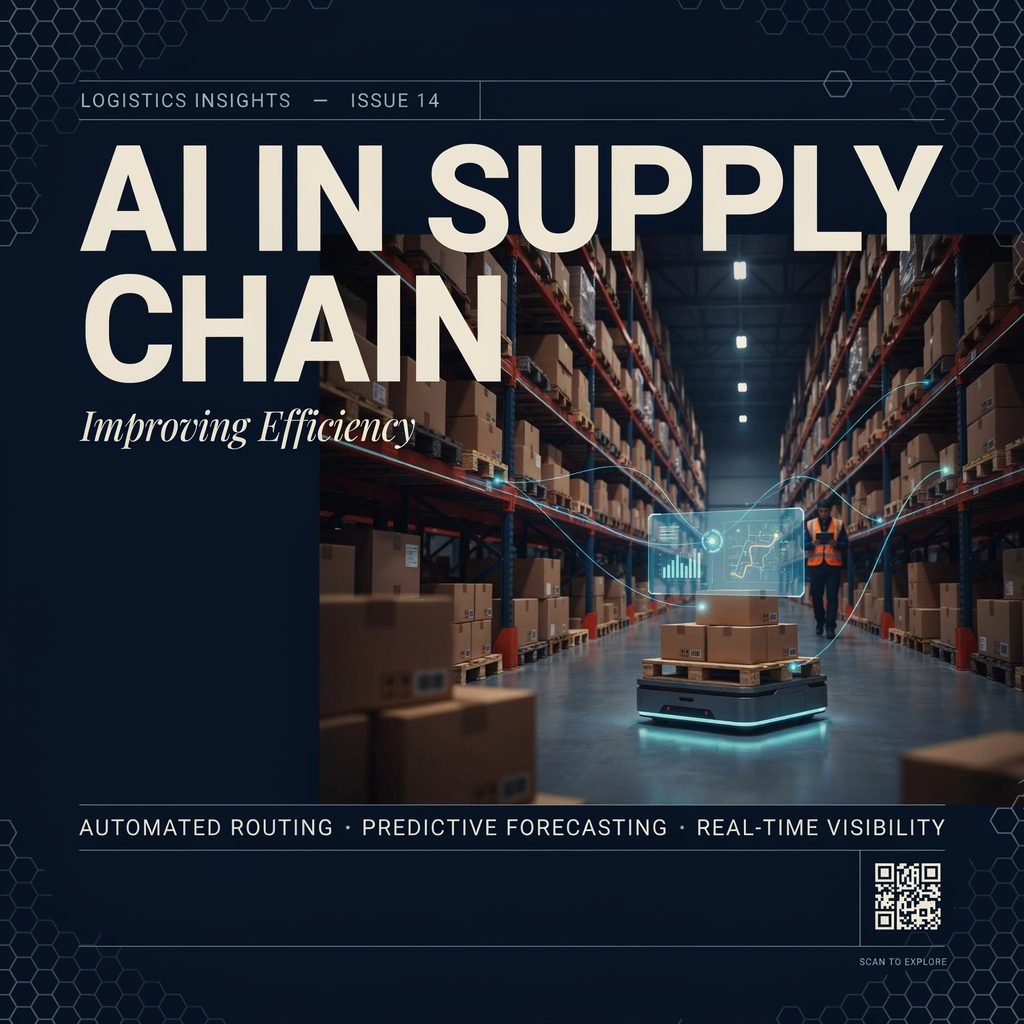
What Is AI-Powered Supply Chain Management?
AI-powered supply chain management refers to the use of machine learning, predictive analytics, computer vision, natural language processing, and real-time data processing to plan, execute, and optimize supply chain activities with minimal manual intervention.
Unlike conventional enterprise resource planning (ERP) systems that record transactions and generate static reports, AI supply chain solutions learn continuously from data patterns. They identify correlations humans might miss, forecast outcomes probabilistically, and recommend—or execute—actions autonomously.
Key technologies powering an AI-powered supply chain include:
- Machine learning in logistics – algorithms that improve forecasting and routing accuracy over time
- Predictive analytics – modeling future demand, delays, or equipment failures
- Computer vision – inspecting products, reading labels, and monitoring warehouse activity
- Natural language processing (NLP) – parsing supplier contracts, customer inquiries, and unstructured data
- Internet of Things (IoT) sensors – feeding real-time location, temperature, and condition data into AI models
- Robotic process automation (RPA) – handling repetitive administrative tasks like purchase order entry
For maximum impact, AI must integrate with your existing warehouse management system (WMS), transportation management system (TMS), ERP platform, and IoT device network. This integration creates a unified data ecosystem where insights flow seamlessly from the factory floor to the last-mile delivery van.
Key Applications of AI in Supply Chain Management
Demand Forecasting and Sales Prediction
AI demand forecasting analyzes historical sales, seasonality, market trends, weather data, promotional calendars, and even social media sentiment to predict future demand with significantly higher accuracy than traditional statistical methods. Retailers and manufacturers use these models for demand planning, reducing both stockouts and excess inventory.
Inventory Optimization and Inventory Management
AI-driven inventory optimization balances carrying costs against service-level targets. Machine learning models determine optimal reorder points, safety stock levels, and replenishment schedules across hundreds or thousands of SKUs simultaneously—something manual planning simply cannot achieve at scale.
Warehouse Automation and Smart Warehousing
A smart warehouse leverages autonomous mobile robots (AMRs), AI-guided picking systems, computer vision for slotting optimization, and predictive labor scheduling. Warehouse automation reduces pick times, minimizes errors, and allows operations to scale during peak seasons without proportional headcount increases.
Route Optimization and Transportation Management
AI route optimization evaluates traffic patterns, weather forecasts, fuel costs, delivery windows, and vehicle capacity to generate optimal delivery route plans in real time. Transportation management systems enhanced with machine learning can reduce empty miles, consolidate shipments, and cut fuel consumption.
Supplier Selection, Performance Monitoring, and Procurement Automation
AI evaluates suppliers on delivery reliability, quality metrics, financial health, and geopolitical risk exposure. Procurement automation streamlines purchase order creation, invoice matching, and contract compliance checks, freeing procurement teams to focus on strategic sourcing and supplier risk management.
Predictive Maintenance
Predictive maintenance uses IoT sensor data from manufacturing equipment and fleet vehicles to forecast failures before they occur. Instead of servicing machines on a fixed schedule, AI triggers maintenance only when wear indicators suggest imminent breakdown—reducing downtime and extending asset life.
Supply Chain Visibility and Real-Time Tracking
Real-time supply chain visibility platforms aggregate data from GPS trackers, IoT sensors, carrier APIs, and customs databases into a single dashboard. AI layers anomaly detection on top, alerting managers when a shipment deviates from its expected path or when transit times exceed thresholds.
Risk Management, Disruption Detection, and Supply Chain Resilience
AI-powered supply chain risk assessment monitors news feeds, weather systems, trade policy changes, and supplier financial filings to flag potential supply chain disruption events early. Scenario modeling helps teams build supply chain resilience by simulating “what-if” situations and identifying alternative sourcing or routing strategies.
Customer Service Automation and Order Fulfillment
NLP-powered chatbots handle order status inquiries, while AI orchestrates order fulfillment by selecting the optimal warehouse, carrier, and shipping method for each order—balancing speed, cost, and customer preference.
Quality Control Using Computer Vision
AI-powered inspections using computer vision cameras detect product defects, packaging errors, and labeling issues on production lines at speeds and consistency levels human inspectors cannot match. This reduces returns, protects brand reputation, and supports compliance.
How AI Improves Supply Chain Efficiency
The measurable benefits of AI in supply chain management extend across every operational metric:
- Cost reduction – Lower transportation, warehousing, and procurement expenses through optimization
- Fewer stockouts and less overstocking – Accurate demand forecasting aligns inventory with actual need
- Improved forecast accuracy – Machine learning models routinely outperform traditional methods by 20–50%
- Shorter delivery times – Optimized routing and warehouse processes accelerate order fulfillment
- Higher warehouse productivity – Automation and AI-guided workflows increase throughput per labor hour
- Reduced human errors – Automated data entry, picking, and inspection minimize costly mistakes
- Better asset utilization – Predictive maintenance and dynamic scheduling keep trucks, machines, and space productive
- Stronger supplier collaboration – Shared AI-driven forecasts and performance dashboards align partners
- Faster decision-making – Real-time analytics replace week-long reporting cycles
- Increased customer satisfaction – Reliable delivery windows, accurate stock availability, and responsive service
Together, these gains compound into significant operational efficiency improvements and stronger margins.
Examples of AI in Supply Chain Management
eCommerce and Retail: A mid-size online retailer uses AI demand forecasting to predict SKU-level sales across regional fulfillment centers. During promotional events, the model adjusts reorder quantities automatically, preventing stockouts on trending items while avoiding overstock on slow movers. The result is tighter inventory management and fewer discounted clearance cycles.
Warehouse Operations: A third-party logistics provider deploys autonomous mobile robots alongside computer vision systems in its distribution center. Robots transport bins to pickers, while overhead cameras verify item accuracy before packing. The smart warehouse processes 40% more orders per shift without adding staff.
Logistics and Transportation: A regional delivery company implements AI route planning that recalculates delivery sequences every 15 minutes based on live traffic and new order insertions. Drivers receive updated routes on mobile devices, reducing average delivery route planning time and cutting fuel usage across the fleet.
Manufacturing: An automotive parts manufacturer installs IoT sensors on CNC machines and uses predictive maintenance algorithms to schedule servicing during planned downtime rather than after unexpected failures, preserving production continuity.
Food Distribution and Healthcare: A food distributor uses AI-powered temperature monitoring and predictive analytics to reduce spoilage during transit. A healthcare supplier applies machine learning to forecast demand for critical medical supplies, ensuring hospitals maintain adequate stock without excessive waste.
These examples illustrate how AI supply chain solutions adapt to diverse industries without requiring a one-size-fits-all approach.
Challenges of Implementing AI in Supply Chains
Despite its promise, AI implementation challenges are real and must be addressed honestly:
- Poor data quality and siloed systems – AI models are only as good as the data they consume. Disconnected spreadsheets, inconsistent naming conventions, and missing records undermine accuracy.
- High initial costs – Licensing, integration, and infrastructure investments can strain budgets, particularly for smaller organizations.
- Cybersecurity and data privacy – Connecting more systems and sharing data with AI vendors increases the attack surface.
- Legacy system integration – Older ERP or WMS platforms may lack modern APIs, complicating ERP integration efforts.
- Skills gap – Supply chain teams may lack data science expertise, requiring training or external partnerships.
- Change management resistance – Employees accustomed to manual processes may distrust or resist AI recommendations.
- Algorithm bias and inaccurate predictions – Models trained on limited or biased data can produce misleading outputs.
- Need for human oversight – AI should augment, not replace, human judgment in high-stakes decisions.
Acknowledging these barriers upfront allows organizations to plan mitigation strategies rather than encounter surprises mid-deployment.
Best Practices for Implementing AI in Supply Chain Operations
A successful AI supply chain strategy follows a disciplined, phased approach:
- Start with a high-impact use case – Choose one area, such as demand forecasting or route optimization, where quick wins build momentum.
- Audit existing supply chain data – Assess completeness, accuracy, and accessibility before feeding data into AI models.
- Set measurable KPIs – Define targets for forecast accuracy, cost reduction, delivery speed, or inventory turns.
- Choose scalable AI tools and technology partners – Select platforms that grow with your volume and complexity.
- Integrate AI with existing ERP, WMS, and TMS platforms – Avoid creating new data silos; ensure bidirectional data flow.
- Run pilot projects before full deployment – Test in one warehouse, one region, or one product category first.
- Train supply chain employees – Equip planners, buyers, and warehouse staff to interpret AI outputs confidently.
- Monitor model performance continuously – Retrain models as market conditions shift; track drift and accuracy decay.
- Establish data governance and cybersecurity controls – Define ownership, access rights, and encryption standards.
- Keep human experts in the loop – Use AI recommendations as decision support, not blind automation, for critical choices.
Following these steps reduces risk and accelerates time-to-value for your AI in supply chain management initiative.
Future of AI in Supply Chain Management
The next wave of artificial intelligence in supply chain operations is already emerging:
- Generative AI in supply chain – Drafting procurement contracts, generating scenario reports, and summarizing supplier communications in natural language.
- Autonomous warehouses – Fully robotic fulfillment centers where AI orchestrates every movement from receiving to shipping.
- Digital twin technology – Virtual replicas of entire supply networks that allow managers to simulate disruptions and test strategies risk-free.
- AI agents and hyperautomation – Autonomous software agents that negotiate, book, and track shipments end-to-end.
- Predictive supply networks – Interconnected AI models spanning multiple trading partners for synchronized planning.
- Autonomous vehicles and drones – Self-driving trucks and aerial delivery for last-mile delivery in select markets.
- Sustainability optimization – AI algorithms that minimize carbon emissions reduction trade-offs, optimize load consolidation to cut fuel usage, reduce packaging waste, and support a sustainable supply chain strategy.
As these technologies mature, supply chain sustainability and operational efficiency will increasingly converge, allowing companies to meet environmental commitments without sacrificing service levels.
Conclusion
AI in supply chain management is far more than task automation. It is the foundation for building smarter, more agile, and genuinely resilient operations capable of thriving amid volatility. From predictive analytics that sharpen demand forecasting to computer vision that safeguards product quality, artificial intelligence in supply chain functions delivers measurable cost reduction, faster decision-making, and stronger customer experiences.
The organizations that gain the most advantage will not be those that adopt every tool at once. They will be the ones that start with reliable data, select one practical AI use case aligned to a clear business goal, measure results rigorously, and scale deliberately.
Your next step: Assess your current supply chain processes this week. Identify one bottleneck—whether it is forecast inaccuracy, excess inventory, or inefficient routing—and explore how a targeted AI pilot could address it. Small, focused experiments build the confidence and data foundation needed for broader transformation.
The future belongs to supply chains that think, adapt, and learn. AI gives yours that capability. Start today.
Frequently Asked Questions
What is AI in supply chain management?
AI in supply chain management uses machine learning, predictive analytics, computer vision, and automation to plan, execute, and optimize supply chain activities—improving forecasting, inventory control, transportation, and risk management with data-driven decision-making.
How does AI improve supply chain efficiency?
AI improves supply chain efficiency by increasing forecast accuracy, reducing stockouts and overstock, optimizing delivery routes, automating repetitive tasks, enabling predictive maintenance, and providing real-time supply chain visibility—all of which lower costs and accelerate operations.
Can small businesses use AI for supply chain management?
Yes. Cloud-based AI supply chain solutions, SaaS demand planning tools, and affordable warehouse management software with built-in analytics make AI accessible to small and mid-size businesses without large upfront infrastructure investments.
What are the most common AI use cases in logistics?
The most common AI use cases in logistics include route optimization, demand forecasting, warehouse automation with autonomous mobile robots, predictive maintenance for fleets, real-time shipment tracking, and last-mile delivery planning.
What is the difference between AI and automation in supply chain management?
Automation follows fixed, rule-based instructions to complete repetitive tasks. AI goes further by learning from data, adapting to new conditions, making predictions, and generating recommendations. Robotic process automation handles a set workflow; AI determines the best workflow dynamically.
What are the risks of using AI in supply chains?
Key risks include poor data quality leading to inaccurate predictions, cybersecurity vulnerabilities, over-reliance on algorithms without human oversight, integration difficulties with legacy systems, algorithm bias, and employee resistance to change. Strong governance, continuous monitoring, and human-in-the-loop controls mitigate these risks.