
AI Assistants Have Outgrown Voice Commands
Remember the first time you said, “Hey Siri, set an alarm for 7 a.m.” or asked Alexa to play your favorite playlist while cooking dinner? For millions of people, that was their first real interaction with an artificial intelligence assistant. It felt futuristic. It also felt limited.
Today, the evolution of AI assistants has moved far beyond those simple voice commands. Modern AI-powered assistants can draft emails, analyze spreadsheets, write marketing copy, summarize legal documents, troubleshoot software bugs, and manage complex workflows across entire organizations. They don’t just listen for a trigger word anymore—they understand context, generate original content, and adapt to individual users over time.
The shift has been dramatic. What started as a digital assistant that could check the weather or set a timer has become an intelligent collaborator capable of supporting creativity, decision-making, and productivity at scale. Whether you’re a small business owner exploring customer support automation or a student using conversational AI to brainstorm essay ideas, AI assistants are reshaping how we interact with technology.
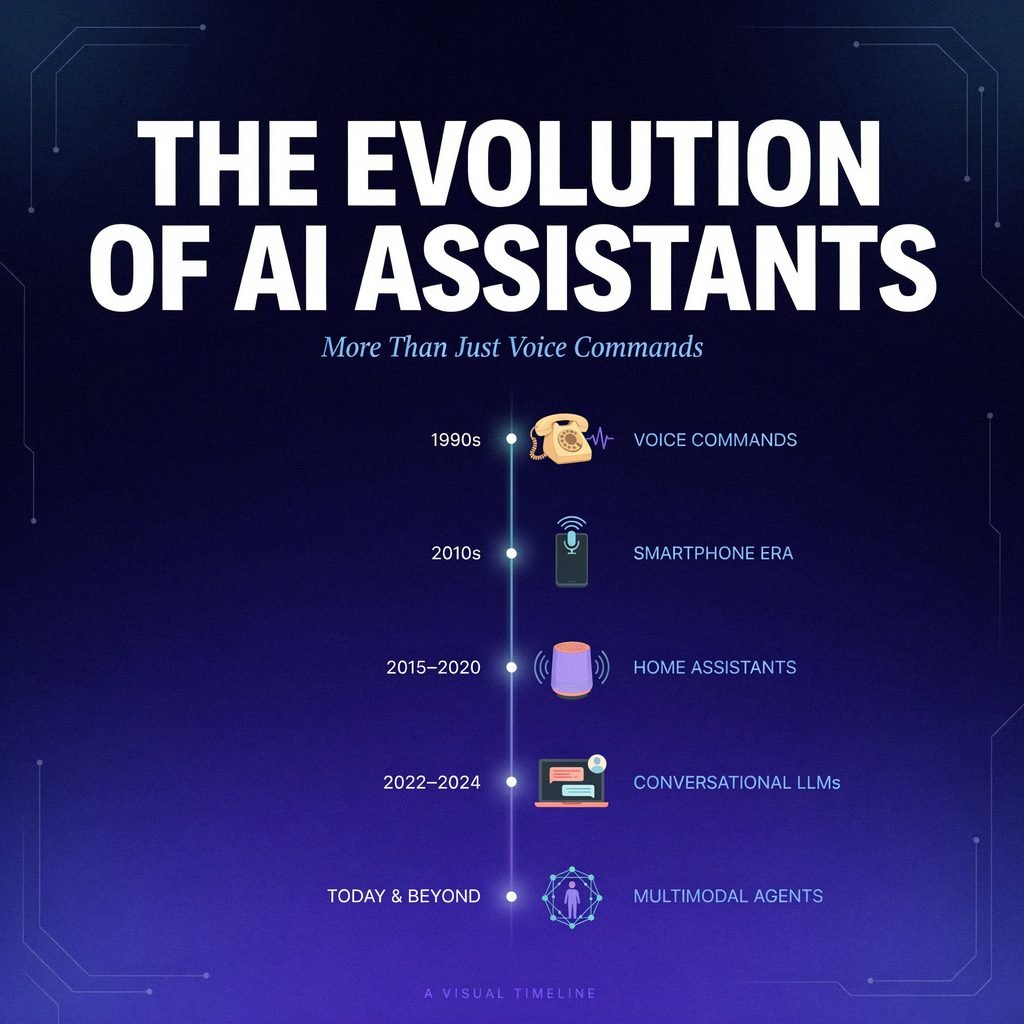
This article walks through that journey—from basic rule-based chatbots to generative AI systems—and explores what’s coming next.
What Is an AI Assistant?
At its core, an AI assistant is software designed to help users complete tasks, answer questions, or manage information using artificial intelligence. But that definition covers a wide spectrum of tools with very different capabilities.
Here’s a quick breakdown:
- Traditional virtual assistants: Early software helpers that followed scripted workflows, like automated phone menus or calendar reminders.
- Voice assistants: Tools like Siri, Alexa, and Google Assistant that respond to spoken commands using speech recognition technology.
- AI chatbots: Rule-based or NLP-driven programs that answer questions in text form, often on websites or messaging platforms.
- Generative AI assistants: Systems powered by large language models (LLMs) that can create original text, code, summaries, and structured outputs based on user prompts.
- AI agents: A newer category of autonomous or semi-autonomous systems that can plan tasks, use external tools, and complete multi-step workflows with minimal human input.
Not every chatbot is equally capable. A simple AI chatbot on a retail website might only pull answers from a fixed FAQ database. A generative AI assistant built on advanced natural language processing can hold a nuanced conversation, adapt its tone, and produce content that didn’t exist before the user asked for it.
The underlying technologies—machine learning, NLP, large language models, and contextual awareness—determine how “intelligent” an assistant actually is.
The Early Days of Digital Assistants
Before Siri ever said, “What can I help you with?”, digital assistance existed in much simpler forms. Automated phone trees guided callers through numbered menus. Spell-checkers flagged typos in word processors. Calendar apps sent reminder notifications. Basic search engines matched keywords to web pages.
These early tools were helpful, but they operated on fixed rules. If your request didn’t match a programmed path, the system failed.
The limitations were significant:
- No context retention: Each interaction started from scratch. The system didn’t remember what you asked thirty seconds ago.
- No understanding of natural conversation: You had to use exact phrasing or menu options.
- Reliance on rigid commands: Misspell a keyword or skip a step, and the process broke.
- Limited personalization: Every user received the same generic response.
- No original output: These systems retrieved pre-written answers. They couldn’t create anything new.
For all their utility, these early digital assistants were essentially sophisticated lookup tools. They saved time on repetitive tasks but couldn’t think, reason, or adapt.
The Rise of Voice Assistants
The launch of Siri in 2011, followed by Google Assistant and Amazon’s Alexa, marked a turning point. Voice assistants brought AI into living rooms, kitchens, and cars. Speech recognition and voice recognition technology improved rapidly, and text-to-speech systems made responses feel conversational.
Suddenly, hands-free computing was practical. Common uses included:
- Setting reminders and alarms
- Making phone calls or sending text messages
- Playing music or podcasts
- Checking weather forecasts
- Controlling smart home technology like lights, thermostats, and locks
- Looking up quick factual answers
Smart home technology, in particular, gave voice assistants a tangible role. Saying “Alexa, turn off the living room lights” felt genuinely useful.
Yet voice assistants still struggled with complexity. Ask a multi-part question, reference something from earlier in the conversation, or request a nuanced explanation, and the system often stumbled. Contextual awareness was limited. Personalization was shallow. The assistant could execute a command but couldn’t truly collaborate.
Voice assistants represented meaningful progress in accessibility and convenience, but they were still reactive tools waiting for specific instructions.
How Generative AI Changed the AI Assistant Landscape
The introduction of generative AI fundamentally altered what people expected from an AI assistant. Tools like ChatGPT and Microsoft Copilot demonstrated that a digital assistant could do more than retrieve information—it could create it.
Powered by large language models trained on vast datasets, these systems use advanced natural language processing to understand detailed prompts and generate coherent, original responses. They can write blog posts, summarize research papers, brainstorm product names, debug code, translate languages, and help users plan complex projects.
A few concepts worth understanding:
- Natural language processing (NLP): The technology that allows machines to interpret, understand, and generate human language.
- Large language models (LLMs): Massive neural networks trained on billions of words, enabling them to predict and generate text that reads naturally.
- Training data: The enormous collections of text used to teach these models patterns in language, reasoning, and structure.
- Context windows: The amount of conversation a model can “remember” within a single interaction, allowing it to reference earlier parts of a discussion.
- Prompt engineering: The skill of crafting clear, specific instructions to get the best possible output from an AI system.
- Generative responses: Outputs created in real time rather than pulled from a fixed database.
The critical distinction is this: modern generative AI assistants don’t simply look up pre-programmed answers. They synthesize, structure, and produce new content based on what you ask. That shift changed user expectations overnight.
From Reactive Tools to Proactive AI Assistants
The next phase in the evolution of AI assistants is the move from reactive to proactive. Instead of waiting for a command, today’s AI-powered assistants can anticipate needs, integrate with other software, and automate workflows.
Contextual awareness and personalized AI allow these tools to learn preferences, remember past interactions, and tailor responses to individual users. Intelligent automation connects assistants to calendars, email platforms, CRM systems, and project management tools.
Practical examples include:
- An assistant organizing meeting notes, extracting key decisions, and producing a list of action items automatically.
- An AI tool drafting follow-up emails after a sales call, personalized to the prospect’s stated interests.
- A customer support assistant answering routine questions 24/7, freeing human agents for complex cases.
- A digital assistant summarizing weekly reports and highlighting trends that require attention.
- A smart home system learning preferred temperatures and lighting routines, adjusting settings without being asked.
- An AI assistant helping a content marketer generate outlines, keyword ideas, social media captions, and content calendars in a single session.
The benefits of workflow automation and task automation are real: faster turnaround, fewer repetitive errors, and more time for strategic thinking. That said, users should always review AI-generated outputs before acting on them, especially in high-stakes contexts.
AI Assistants in Everyday Life
Artificial intelligence assistants have quietly woven themselves into daily routines. Beyond the obvious smart speaker interactions, they now touch nearly every digital experience:
- Smart homes: Voice-controlled lighting, security cameras, thermostats, and appliances.
- Mobile devices: Predictive texting, photo organization, and on-device AI features.
- Online shopping: Personalized product recommendations and AI-driven customer service.
- Education: Tutoring tools, language-learning apps, and research assistants.
- Travel planning: Itinerary suggestions, real-time translation, and booking assistance.
- Health and fitness: Wearable devices that track activity, analyze sleep patterns, and offer wellness insights.
- Entertainment: Recommendation engines for streaming music, video, and reading.
- Accessibility: Speech-to-text for hearing-impaired users, text-to-speech for visually impaired users, and real-time translation for multilingual communication.
Multimodal AI—systems that process text, voice, images, and video together—is making these experiences richer. You can now snap a photo of a restaurant menu in another language and get an instant translation, or describe a problem verbally and receive a step-by-step visual guide.
AI Assistants in the Workplace
Enterprise AI and AI virtual assistants are transforming business operations. Digital transformation initiatives increasingly place intelligent automation at the center of strategy.
Key workplace applications include:
- Customer service and customer support automation: Handling inquiries, processing returns, and escalating complex issues.
- Sales and lead management: Qualifying leads, drafting outreach emails, and updating CRM records.
- Human resources: Screening resumes, answering employee policy questions, and onboarding new hires.
- Marketing and content creation: Generating ad copy, social posts, email campaigns, and SEO content.
- Software development: Writing code snippets, reviewing pull requests, and debugging errors.
- Data analysis and reporting: Summarizing datasets, generating charts, and identifying anomalies.
- Internal knowledge management: Making company documents searchable and answering internal queries instantly.
- Project management: Tracking deadlines, assigning tasks, and flagging bottlenecks.
- Business process automation: Streamlining approvals, invoicing, and compliance checks.
Consider a practical example. A small e-commerce business receives hundreds of customer questions daily. An AI-powered assistant can respond to common queries about shipping times and return policies instantly, summarize incoming support tickets, draft empathetic replies for review, and route genuinely complex complaints to a human employee. The result is faster response times, improved customer experience, and a support team that focuses on issues requiring judgment and empathy.
The Rise of AI Agents and Autonomous Workflows
The newest chapter in the evolution of AI assistants involves AI agents—systems designed not just to respond, but to plan, act, and complete multi-step tasks with a degree of autonomy.
The distinction matters:
- A standard AI chatbot responds to a user prompt with a single answer or output.
- An AI agent can break a goal into subtasks, retrieve information from multiple sources, use connected tools (calendars, databases, APIs), and execute a sequence of actions to reach an outcome.
For example, an autonomous agent might receive the instruction, “Prepare a quarterly sales report and email it to the leadership team.” It could pull data from a CRM, generate charts, write a summary, format the document, and send the email—all with minimal human intervention.
However, human oversight remains essential. In financial decisions, legal matters, healthcare recommendations, cybersecurity protocols, and customer-facing communications, the stakes are too high for fully autonomous action. Responsible AI practices demand that humans review, approve, and remain accountable for critical outputs.
Key Challenges and Risks
For all their capability, AI assistants are not infallible. A balanced view requires acknowledging real risks:
- Data privacy: Assistants often process personal information. Users should understand how their data is stored, used, and shared.
- Cybersecurity threats: Connected AI systems can become attack vectors if not properly secured.
- AI hallucinations: Large language models can generate plausible-sounding but factually incorrect information.
- Algorithmic bias: Training data may reflect historical biases, leading to unfair or skewed outputs.
- Overreliance on automation: Delegating too much decision-making to AI can erode critical thinking skills.
- Lack of transparency: Users may not understand how an AI reached a particular conclusion.
- Intellectual property concerns: Questions about ownership of AI-generated content remain legally unsettled.
AI ethics and responsible AI frameworks exist to address these issues, but implementation varies. As a user, you can protect yourself by verifying facts independently, avoiding sharing sensitive personal or financial information unnecessarily, choosing platforms with clear privacy practices, and treating AI outputs as drafts rather than final answers.
What Is the Future of AI Assistants?
The future of AI assistants points toward deeper integration, greater personalization, and more natural interaction. Likely developments include:
- More personalized AI experiences that adapt to individual communication styles and preferences.
- Better contextual memory allowing assistants to reference past conversations across sessions.
- Multimodal AI that seamlessly handles text, voice, images, video, and documents in a single interaction.
- More natural real-time conversations with reduced latency and improved emotional understanding.
- Deeper integration with workplace software, making AI a built-in layer of every productivity tool.
- Expanded AI agent capabilities for increasingly complex autonomous workflows.
- Improved responsible AI practices, stronger privacy controls, and clearer regulatory frameworks.
- Greater human-AI collaboration, positioning AI as a partner that augments human skills rather than replacing them.
These are directions, not guarantees. Progress will depend on research breakthroughs, regulatory decisions, and public trust. What seems unlikely is a future where AI assistants simply disappear. They are becoming infrastructure.
Conclusion
The evolution of AI assistants is a story of expanding capability—from rigid phone menus to voice commands to generative, context-aware, multimodal collaborators. Today’s tools support communication, creativity, data analysis, intelligent automation, and decision-making in ways that would have seemed like science fiction two decades ago.
Yet their greatest value emerges not from blind trust but from thoughtful use. AI assistants enhance human work best when people review outputs, verify facts, maintain oversight, and treat the technology as a capable partner rather than an unquestioned authority.
Whether you use AI to manage your schedule, create content, support customers, or streamline business workflows, learning how to work effectively with AI assistants may become one of the most valuable digital skills of the coming years. The tools are ready. The question is how thoughtfully we choose to use them.